
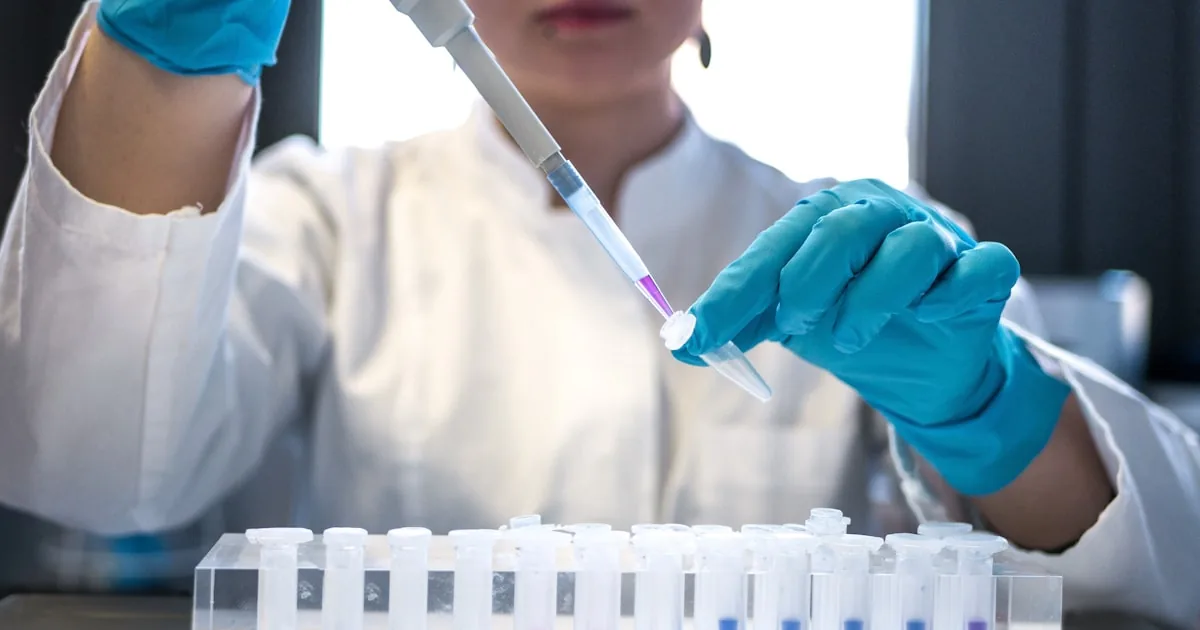
When a customer asks “is this product safe?”, the honest answer isn’t on the label. It’s in the QC release file. Here are the 12 tests we run on every batch before it ever leaves Srebrenik, and what each one rules out.
Why 12, not 4
The legal minimum (EU and U.S.) is roughly four tests: identity, microbiological, heavy metals, and disintegration for solid dose forms. Those will get a product through an audit. They will not catch every problem, and most of the shelf stops there. Here’s what 12 looks like.
The 12 tests
1. Identity (HPLC or FTIR)
Confirms the raw material is what the supplier says it is. We’ve caught labelled “Curcuma Longa 95%” that came in at 78%. Cheap to test, expensive to skip.
2. Active assay (potency)
Quantifies the actual mg of the active in the finished form. Label claim says “Vitamin D3 5,000 IU”? The assay shows what’s really there. Acceptance: typically ±10% of label claim.
3. Disintegration (solid dose forms)
Capsule or tablet must break down within 30 minutes in simulated gastric fluid. If it doesn’t, the active never reaches the bloodstream and the capsule is a swallowing exercise.
4. Dissolution
One step beyond disintegration: how much of the active dissolves into solution within a target time window. Required for any controlled-release formulation and good practice for everything else.
5. Weight uniformity
Sample 20 units, weigh each. Variance must stay within USP limits. Catches dosing errors before they become customer complaints.
6. Microbiological, total aerobic count
How many viable bacteria per gram. Limit varies by product type. Failure usually points to humidity or hygiene issues.
7. Microbiological, yeast and mould
Separately quantified. Yeast/mould failures typically point to raw material contamination (especially herbal extracts) or packaging integrity issues.
8. Microbiological, pathogens (E. coli, Salmonella, S. aureus)
Zero tolerance. A single positive = batch rejected, recall procedure activated, root cause investigation.
9. Heavy metals, lead
EU limit: variable by product type. We hold every batch to one fifth of the EU maximum. Lead is the contaminant most likely to fail Prop 65 in California.
10. Heavy metals, cadmium, mercury, arsenic
Same one fifth ceiling. Arsenic in particular is a common contaminant in seaweed, fish oil, and certain Asian-sourced botanicals.
11. Moisture content (Karl Fischer or oven loss)
Out-of-spec moisture in powders or capsules accelerates degradation, encourages microbial growth, and ruins shelf life. We measure on every batch.
12. Visual / appearance
Sounds basic, is critical. Color, shape, surface defects, foreign particles, label print quality. Last line of defence before shipping.
What “passing” actually looks like
Every batch generates a Certificate of Analysis listing all 12 tests with measured values vs specification. We file it, and it stays available for the life of the batch. Any customer can email the batch number printed near the expiry date to info@pharmscale.com and get the independent lab’s certificate for that exact batch back, usually within a few hours. No account, no forms.
What we do when a test fails
Internal release testing failure = batch quarantined, never leaves the facility. We re-make it at our own cost. Because we sell these products ourselves rather than manufacturing them for anyone else, a failed batch costs us and nobody else. There is no client deadline pushing a marginal batch out of the door, and nobody to argue with us about whether it’s good enough. That is the whole reason we don’t take outside production work.
Where third-party testing fits
Two laboratories clear every released batch: our own QC lab in Srebrenik, and one independent accredited third-party lab. We maintain relationships with three accredited EU and U.S. labs and send each batch to the one accredited for the market that batch is shipping into. The facility itself is FDA registered (No. 14287957814) and manufactures to 21 CFR Part 111, and is audited on site every year by TÜV Thüringen under DAkkS accreditation against ISO 22000 (Reg. 1515426366) and ISO 22716 (Reg. 1528626076).